

For 10,000 years, farmers have followed the same exhausting cycle: plow, sow, grow, harvest, repeat. Rice—the staple food for more than half of humanity—has always been an annual crop, dying after each harvest and requiring replanting season after season.
But what if rice could behave more like an orchard? Planted once, harvested year after year?
That vision is now closer to reality. A team of Chinese scientists has identified the key genes that allow wild rice to live for years, and they have successfully reintroduced this “longevity” trait into cultivated rice.
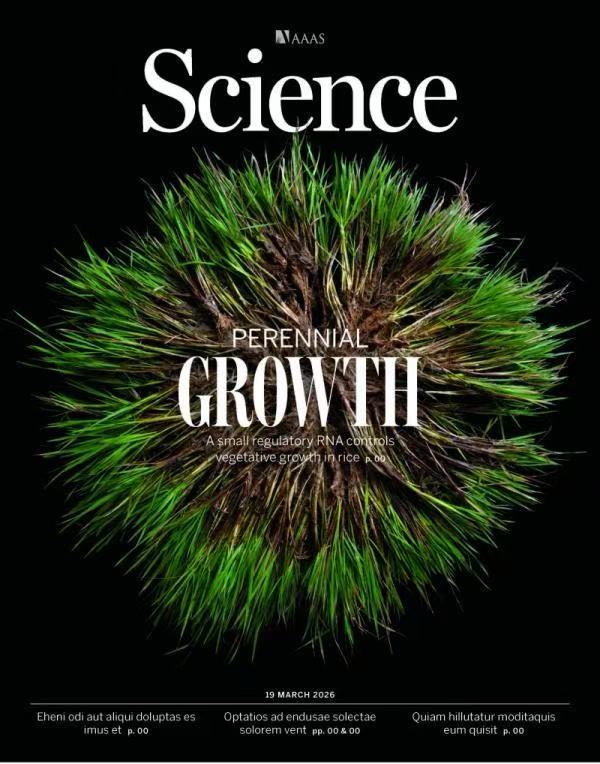
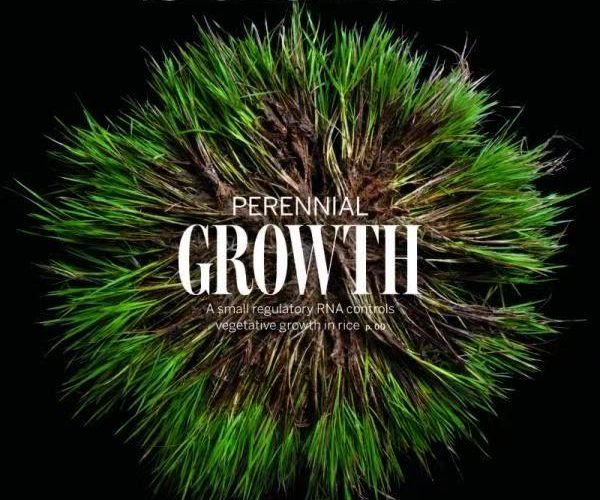
Perennial growth. A small regulatory RNA controls vegetative growth in rice.
Credit: Science, AAAS, 19 March 2026.
The 8-Year Quest
The research, led by Academician Han Bin and Professor Wang Jiawei at the Center for Excellence in Molecular Plant Sciences, Chinese Academy of Sciences, represents nearly a decade of painstaking work. Their findings were published as the cover story in the journal Science on March 20, 2026.
The team began by examining 446 samples of wild rice (Oryza rufipogon), the ancestor of today’s cultivated rice. Unlike the rice we eat, some wild rice plants don’t die after producing seeds. Instead, they keep growing—sending out new branches that take root and become new plants.
Using advanced genetic mapping techniques, the scientists pinpointed the gene responsible—a region they named EBT1, short for Endless Branches and Tillers 1.
In annual rice, certain genes tell the plant when to stop growing and start producing grain—a one-way trip to senescence. But in wild rice, these same genes reactivate after flowering, sending a signal to “start over.”
“You can think of it as a biological reset button,” explained Wang Jiawei.
The Gene Humans Accidentally Discarded
For thousands of years, as humans domesticated wild rice into the high-yielding varieties we know today, this perennial trait was quietly lost. Farmers selected for compact plants that put all their energy into grain production—a single, bountiful harvest rather than sustained, multi-year growth.
“We inadvertently discarded the perennial genes while selecting for higher yields and more compact plant architecture,” Han Bin told reporters.
Now, the team has put them back. By combining EBT1 with two other genes associated with the wild rice growth habit, the researchers created a plant with powerful clonal reproduction abilities. In field trials on Hainan Island, these plants have survived and produced grain for at least two years from a single planting.
What This Means for the World
The implications of this breakthrough extend far beyond a laboratory discovery.
For farmers, perennial rice could dramatically reduce labor costs. According to field trials conducted by Yunnan University, farmers switching from annual to perennial rice used nearly 60 percent less labor and spent almost 50 percent less on seeds and fertilizer.
For the environment, the benefits are equally striking. When farmers switch from annual to perennial rice, soils accumulate nearly one ton of organic carbon per hectare per year—helping combat climate change while reducing erosion.
For food security, perennial rice is particularly suited for sloping farmland and hilly areas where large-scale machinery can’t be used—regions that often face the greatest food security challenges.
From Rice Paddy to Rice Orchard
Science magazine editor Erik Stokstad captured the vision perfectly: “Imagine a grain that grows back year after year without plowing and reseeding. Farmers would save labor, and soil erosion would be reduced.”
The research team is now focused on translating their findings into practical applications. Han Bin told Xinhua News Agency that strengthening collaboration between research institutes and industry could help turn these scientific advances into real-world solutions.
“We believe that visions like Yuan Longping’s ‘dream of enjoying shade under rice plants’ and the international scientific community’s vision of ‘turning rice fields into orchards’ could become reality in the near future,” Han said.
A Global Collaboration
While this breakthrough comes from China, it builds on decades of international collaboration. The development of perennial rice has involved researchers from the International Rice Research Institute (IRRI), the University of Illinois, the University of Queensland, and The Land Institute in the United States.
Since 2018, when the first high-yielding perennial rice variety was released to farmers in China, the area under perennial rice cultivation has steadily expanded. Farmers have reported profits from perennial rice ranging from 17 to 161 percent above annual rice.
As Moto Ashikari, a plant geneticist at Nagoya University, noted: “This provides a compelling proof of concept that annual crops might be converted into perennial crops through genetic approaches.”
The Road Ahead
The discovery of EBT1 is just the beginning. Researchers now have a powerful new tool for breeding perennial rice varieties that combine the longevity of wild rice with the high yields farmers need.
For the 4 billion people who depend on rice as their staple food, the vision of a perennial “rice orchard” represents more than scientific curiosity. It offers hope for a future where farming is less labor-intensive, more sustainable, and better equipped to feed a growing world.
After 10,000 years of planting, plowing, and replanting, that future may finally be within reach.
Sources: Science (March 2026), Chinese Academy of Sciences, Xinhua News Agency, CGTN, The Land Institute