
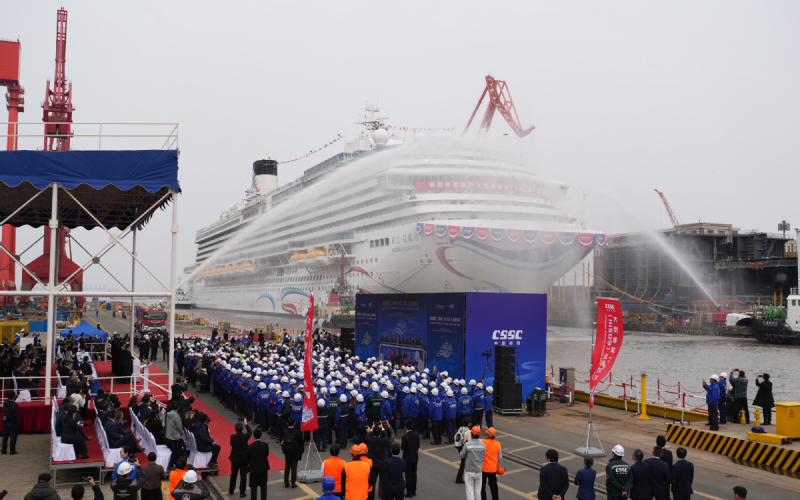
On March 20, 2026, a massive vessel slowly emerged from its construction dock in Shanghai, guided by nine tugboats. The Adora Flora City, China’s second domestically built large cruise ship, was successfully undocked—marking not just another milestone, but proof that the nation has conquered what many considered the “impossible” problems of shipbuilding.
Just two years and three months after the first domestic cruise ship, Adora Magic City, was delivered, China has achieved the leap from exploration to excellence. The journey from “one ship” to “a fleet” has begun.
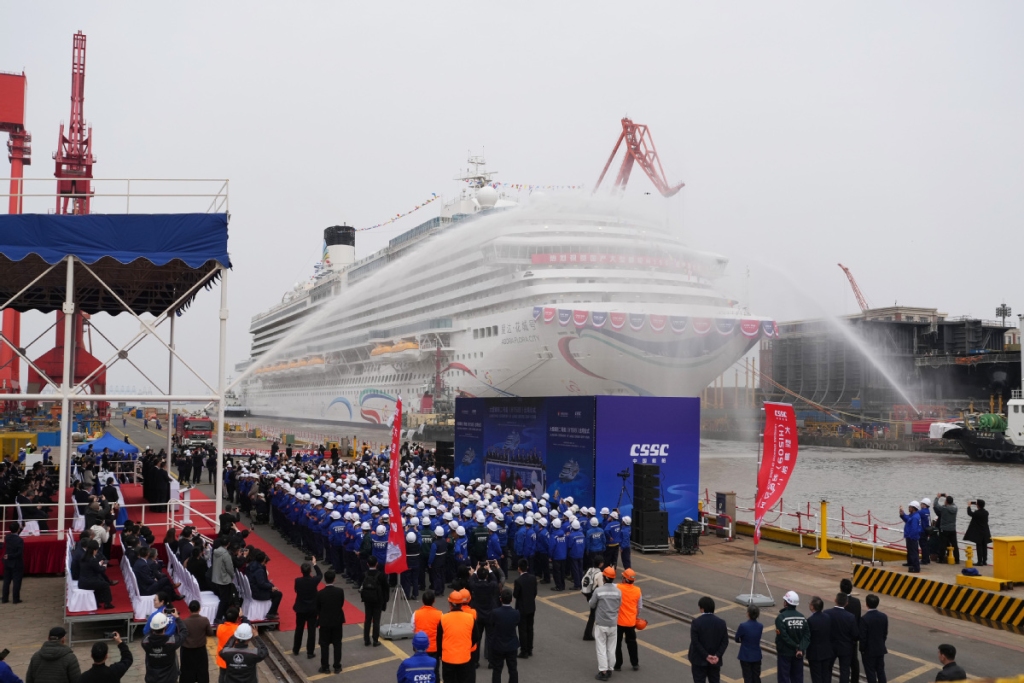
Naming and delivery ceremony of China’s domestically built large cruise ship “Adora Floracity”
Credit: Courtesy of China State Shipbuilding Corporation (CSSC)
World-Class Challenges, Chinese Solutions
For decades, global large cruise ship construction was dominated by three European shipyards. Any shipbuilder hoping to enter this field had to overcome three core challenges that industry insiders call the “Everest” of maritime engineering.
Vibration and Noise Control. A cruise ship is a floating city. With thousands of passengers resting and relaxing across dozens of decks, even the slightest vibration or hum can ruin the experience.
Safe Return to Port. A cruise ship must ensure that in any emergency—fire, flooding, or power failure—passengers can safely return to port without external assistance.
Weight Control. A cruise ship is top-heavy by design, with dozens of passenger decks stacked high above the waterline. Every added kilogram must be precisely balanced against stability requirements.
When China began its journey into large cruise ship construction with Adora Magic City, these were the hurdles. By the time Adora Flora City entered the water, Chinese shipbuilders had not only cleared them but had done so faster and smarter.
Three Upgrades, Comprehensive Excellence
Adora Flora City is not merely a copy of its predecessor. In the words of project commander Chen Gang, it represents a “comprehensive upgrade” across three dimensions.
Larger. The ship’s gross tonnage has increased to 141,900 tons—6,400 tons more than the first vessel. It stretches 341 meters in length and features 2,130 cabins, accommodating up to 5,232 passengers.
Greener. New desulfurization towers and selective catalytic reduction systems significantly reduce emissions, meeting increasingly stringent international environmental standards.
Smarter. Artificial intelligence has been integrated into control systems and passenger services, from smart cabins to AI-enhanced entertainment experiences—representing a new frontier in digital shipbuilding.
Based on passenger feedback from the first ship, designers also expanded open-air decks and shopping areas, and introduced new facilities including a 1,000-seat theater, an art gallery, and a spa.
A Leap in Speed and Efficiency
The construction cycle for the second ship was shortened by eight months—nearly 20 percent faster than the first vessel. Overall construction efficiency improved by 20 percent, while the localization rate increased by five percentage points.
Behind these numbers lies the emergence of a complete industrial ecosystem. Shanghai Waigaoqiao Shipbuilding has now built a “1+100+1500” supply chain: one assembly enterprise, 100 major contractors, and 1,500 suppliers working in concert.
Key systems that were previously imported—including the theater system—are now being supplied by domestic companies for the first time. The ship contains over 2,000 sets of critical equipment and more than 25 million components.
From One Ship to an Industry
“From building one ship to building a system, the domestic cruise industry’s ability to control the entire lifecycle has significantly improved,” Chen Gang said during the undocking ceremony.
The future is already being planned. On the day Adora Flora City left the dock, China Tourism Group and China State Shipbuilding Corporation signed a memorandum of understanding for new cruise ship construction, establishing a “2+1” framework. The goal is to deliver China’s first independently designed large cruise ship by 2030.
Two Ships, A National Industry Takes Shape
The second cruise ship is named after Guangzhou (the “Flower City”) and will be home-ported at Guangzhou Nansha International Cruise Home Port after delivery. This reflects the expansion of China’s cruise market across its coastline. Currently, Adora Cruises operates three large vessels on routes covering eastern, southern, and northern China, as well as Hong Kong, achieving year-round operations from multiple home ports.
The first domestic cruise ship, Adora Magic City, has already carried nearly 690,000 domestic and international passengers since its commercial debut in January 2024.
The Crown Jewel, The Future Has Arrived
The shipbuilding industry often refers to large cruise ships as the “crown jewel”—more complex than aircraft carriers. For decades, only a handful of European shipyards could wear that crown.
Today, China has not only demonstrated its ability to build such ships, but has proven that each iteration can be completed faster. The third ship—China’s first independently designed cruise vessel—is already on the horizon.
By the end of 2026, Adora Flora City will set sail from Guangzhou to international destinations. For the global cruise industry, the message is clear: the barriers that long protected the market are coming down. For passengers, this means more choices and better experiences.
And for the engineers and shipbuilders who conquered the “impossible” problems, this is only the beginning.
Sources: Xinhua News Agency, CCTV, China Daily, Shanghai Waigaoqiao Shipbuilding, Adora Cruises